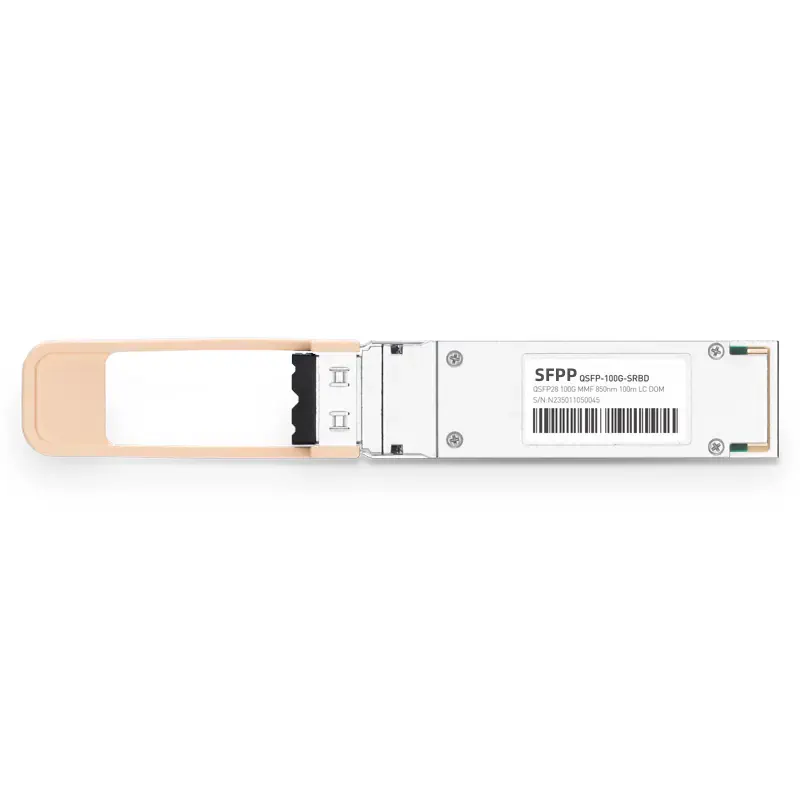
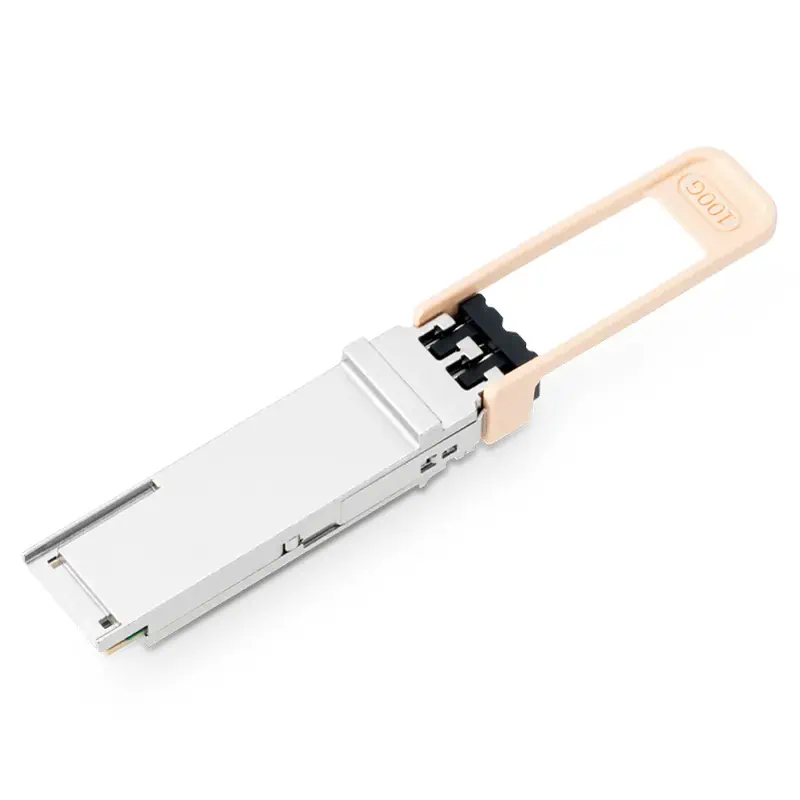
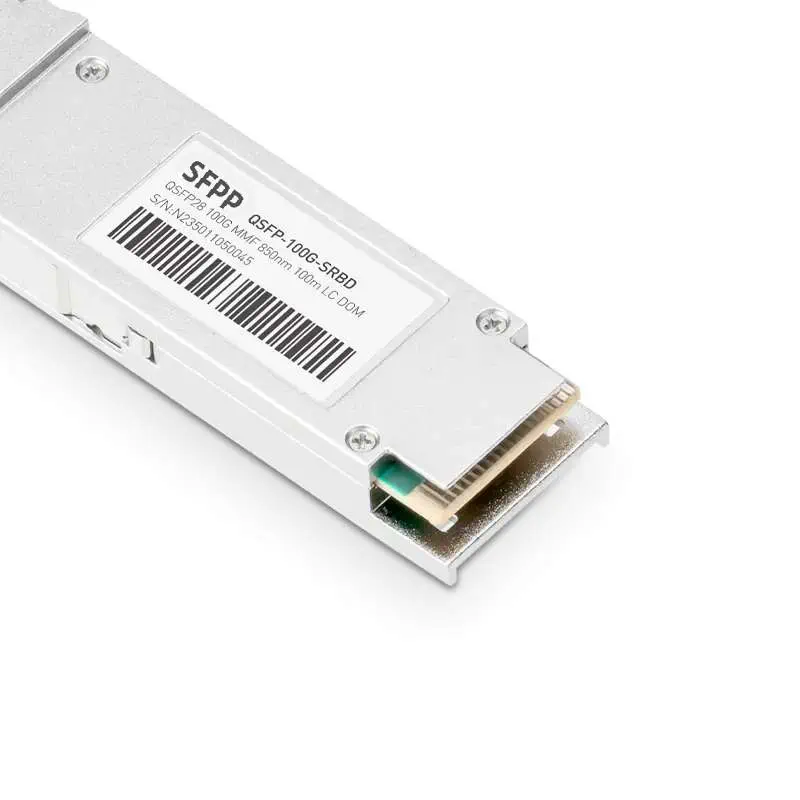
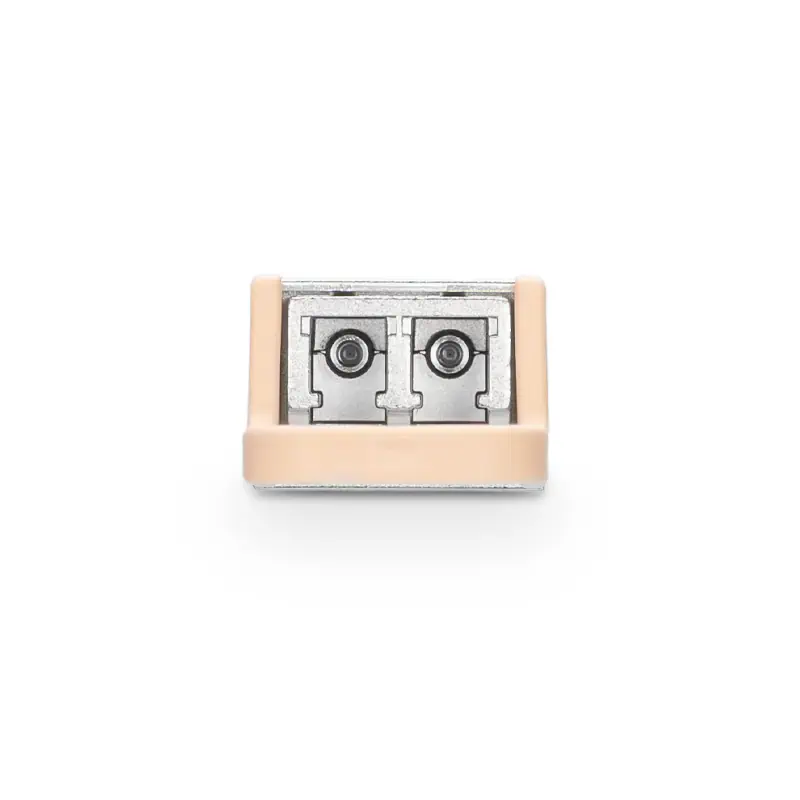
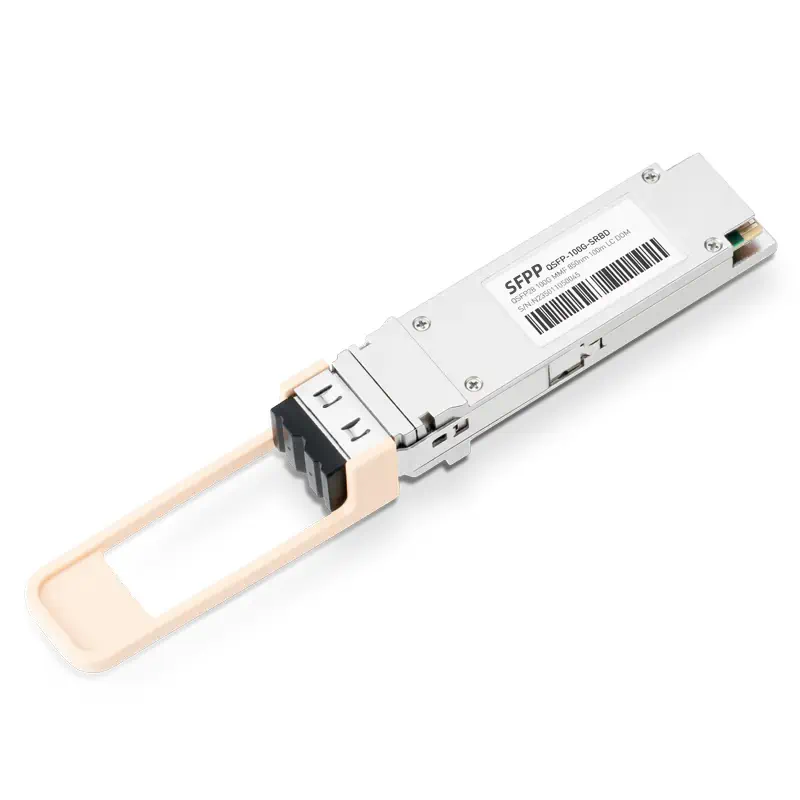
Generic Compatible 100GBASE-SRBD QSFP28 4x25G NRZ 850/910nm 100m MMF DOM LC Duplex Optical Transceiver Module

$389.00

SKU: 94B1645C59E3

Product Highlights

  • Maximum Power Consumption: ≤3.5W.
  • Professional Compatibility Testing and Optical Parameter Test Reports Available.
  • Hot-Pluggable QSFP28 Form Factor; Compliance with Applicable MSA and IEEE Standards Should Be Verified Against the Product Datasheet.
  • Class 1 Laser Safety, RoHS Compliant, and Lead-Free.
  • 30-Day Free Returns, 1-Year Free Replacement, 3-Year Warranty, and Lifetime After-Sales Technical Support.

QSFP-100G-SRBD 100G Bidirectional Multimode Optical Transceiver

The QSFP-100G-SRBD is a 100G QSFP28 optical transceiver designed for short-reach, high-bandwidth connectivity in data centers, enterprise networks, and high-performance computing environments. Using bidirectional optical transmission over duplex multimode fiber, it provides an alternative to parallel-fiber solutions for compatible 100G links.

With a duplex LC interface, the QSFP-100G-SRBD supports connectivity through compatible multimode fiber cabling and can help simplify fiber management in high-density network deployments. Typical supported distances include up to 70m over OM3 fiber and 100m over OM4 fiber, subject to the module datasheet and link conditions. Its maximum power consumption of 3.5W supports power-efficient 100G connectivity.

The hot-pluggable QSFP28 form factor enables convenient installation and replacement in compatible network equipment. Before deployment, verify the module’s optical wavelengths, lane architecture, fiber type, reach, and equipment compatibility. Interoperability with other 100G modules, including SWDM4 variants, should be confirmed against the respective product specifications.

SFPPlaza provides professional compatibility testing and optical parameter test reports to help customers evaluate module performance and system interoperability. The product is backed by a 30-day free return policy, 1-year free replacement, a 3-year warranty, and lifetime after-sales technical support.

Specifications

Part Number QSFP-100G-SRBD Vendor Name SFPPlaza
Form Factor QSFP28 Max. Data Rate 100Gbps
Wavelength 850nm Max. Cable Distance 70m (OM3) /100m (OM4) /150m (OM5)
Connector Duplex LC Media MMF
Transmitter Type VCSEL Receiver Type PIN
Max. Power Consumption ≤3.5W Protocols 100G Ethernet Compliant
DDM/DOM Supported Commercial Temperature Range 0 to 70°C (32 to 158°F)
Modulation (Electrical) 4x25G NRZ Modulation (Optical) 2x50G PAM4

Highlights

100% Compatibility Validated for Arista, NVIDIA, Cisco & Broadcom RoCE Networks

SFPPlaza optical transceivers, AOCs, and DACs undergo rigorous compatibility and interoperability testing with leading RoCE networking platforms, including Arista 7060XE7 and 7060X6 Series data center switches, NVIDIA Spectrum-4 SN5000 Series switches, Cisco N9100 and Nexus 9364E-SG2 Series switches, and Broadcom BCM57708 and BCM957608 NICs. Designed for high-performance RoCE and AI data center networks, our connectivity solutions deliver reliable high-speed data transmission, stable link performance, and seamless integration across demanding network environments.

NVIDIA/Mellanox (Ethernet) 920-9N42F-00RI-3C1, MSN4700-WS2FC, 900-9X81E-00EX-ST0, MCX75310AAS-NEAT, B3240, MCX623105AC-VDAT
Arista 7060XE7-128PE, 7060X6-64PE, 720R4-128PE, 7060DX5-32, 7050DX4-32S, 7280DR3A-54
Juniper QFX5240-64QD, QFX5700, QFX5220-32CD, QFX5120-48T, QFX5110-32Q
Cisco N9164E-NS4-O, N9364E-SG2-Q, Nexus 9364D-GX2A, Nexus 9504, 8501-SYS-MT, Nexus 3432D-S, N9K-X9400-16W(200G)
Broadcom P1800GO, BCM957608-P1400GDF00, BCM957508-N1200G
HUAWEI CE9875-64EO, CloudEngine 16804, CloudEngine 9865-4C, CloudEngine S6780-H4Z, CloudEngine 6885-48YS8CQ-T
H3C S9827-64EP, S9857-24DH8EP, S9855-32D, S9820-8C
Nokia 7220 IXR-H5-32D, 7220 IXR-H2

Questions & Answers

QSFP-100G-SRBD: Frequently Asked Questions

Q: What is the maximum transmission distance of the QSFP-100G-SRBD?

A: The QSFP-100G-SRBD can support transmission distances of up to 70m over OM3 multimode fiber and 100m over OM4 multimode fiber, depending on the module specifications and link conditions. If you plan to use OM5 fiber, verify the supported reach in the manufacturer’s datasheet before deployment.

Q: What is the difference between 100G SRBD, 100G SWDM4, and 100G SR4?

A: The main differences are their optical lane architectures and fiber interfaces. A typical 100G SR4 module uses parallel optical lanes and an MPO/MTP interface, while 100G SRBD and SWDM4 modules typically use duplex LC multimode fiber. SRBD uses two bidirectional optical channels, whereas SWDM4 uses four wavelengths with wavelength multiplexing. Both LC-based solutions can reduce the number of fibers required in the cabling plant compared with SR4, but reach and interoperability depend on the exact module specifications.

Q: What type of fiber connection does the QSFP-100G-SRBD use?

A: The QSFP-100G-SRBD typically uses a duplex LC connector with multimode fiber (MMF). Select compatible fiber cabling based on the module’s specified reach, supported fiber grade, and optical requirements.

Q: What are the key features of the QSFP-100G-SRBD?

A: The QSFP-100G-SRBD is a 100G QSFP28 bidirectional multimode optical transceiver designed for short-reach data center connectivity. It uses duplex LC multimode fiber and bidirectional optical transmission to send and receive data over two fibers, with an aggregate data rate of up to 100Gb/s. Its maximum power consumption is 3.5W, making it suitable for high-density network environments where power efficiency is important. Confirm the exact lane rate, wavelengths, and supported fiber distances in the product datasheet.

Q: Can the QSFP-100G-SRBD interoperate with a QSFP-100G-SWDM4?

A: Direct interoperability should not be assumed. SRBD and SWDM4 use different optical channel and wavelength architectures. Even if both modules use duplex LC multimode fiber, their transmit and receive wavelengths, optical specifications, and encoding requirements may differ. Before connecting them, confirm that the specific module datasheets explicitly support interoperability at both ends of the link.
x