
Ethernet vs. InfiniBand Optical Modules: Can They Be Interchanged?
Ethernet and InfiniBand (IB) optical modules can look almost identical. They may share the same form factor, wavelength, fiber type, and nominal data rate. But does that mean an Ethernet optical transceiver can work in an InfiniBand network, or vice versa?
The short answer is: sometimes, but not always. Compatibility depends on the specific transceiver, host interface, physical-layer requirements, and equipment vendor's compatibility policy. In this guide, SFPPlaza explains how Ethernet and InfiniBand optical modules work, what distinguishes them, and what to check before using them in your network.
1. What Is the Difference Between Ethernet and InfiniBand Optical Modules?
Both Ethernet and InfiniBand optical modules convert electrical signals into optical signals for transmission over fiber. At the receiving end, the optical signals are converted back into electrical signals.
The key difference is the network technology and the physical-layer requirements for which the transceiver is designed.
Ethernet Optical Modules
Ethernet optical modules are designed for Ethernet interfaces and the corresponding physical-layer standards, such as IEEE 802.3. They are widely used in data center switches, Ethernet network interface cards (NICs), routers, and enterprise networks.
Common Ethernet optical module standards include:
- 10GBASE-SR for short-reach multimode fiber connections.
- 100GBASE-SR4 for 100G multimode fiber links.
- 400GBASE-DR4 for 400G single-mode fiber connections.
- 800GBASE-DR8 for high-speed single-mode fiber links.
InfiniBand Optical Modules
InfiniBand optical modules are designed for InfiniBand interconnects, which are widely used in high-performance computing (HPC), AI training clusters, and GPU-to-GPU communication networks.
InfiniBand defines its own link-layer and physical-layer requirements. Common InfiniBand generations include SDR, DDR, QDR, FDR, EDR, HDR, NDR, and XDR.
These networks prioritize high bandwidth, low latency, and efficient communication between servers, GPUs, host channel adapters (HCAs), and InfiniBand switches.
2. How Do Ethernet and InfiniBand Optical Modules Work?
At a basic level, both types of optical modules perform the same signal-conversion function. However, the electrical interfaces and signal requirements must match the host equipment.
How an Ethernet Optical Link Works
- An Ethernet switch or NIC generates electrical signals according to its Ethernet physical-layer interface.
- The optical transceiver converts the electrical signals into optical signals.
- The optical signals travel through single-mode or multimode fiber.
- The receiving transceiver converts the optical signals back into electrical signals for the receiving device.
How an InfiniBand Optical Link Works
- An InfiniBand HCA or switch generates signals compatible with the relevant InfiniBand link generation.
- The optical transceiver converts the electrical signals into optical signals that meet the module's specifications.
- The optical signals travel through the fiber-optic link.
- The receiving transceiver converts the optical signals back into electrical signals for the InfiniBand device.
Important: The optical transceiver does not normally implement the entire Ethernet or InfiniBand protocol stack. Protocol functions are primarily handled by the host NIC, HCA, switch ASIC, and associated circuitry. The transceiver must nevertheless support the appropriate electrical and optical interface requirements.
3. Ethernet vs. InfiniBand Optical Modules: Key Differences
The following table summarizes the main differences between the two types of optical transceivers.
| Feature | Ethernet Optical Modules | InfiniBand Optical Modules |
|---|---|---|
| Network protocol | Ethernet, based on applicable IEEE standards | InfiniBand, based on applicable IBTA specifications |
| Typical applications | Data centers, enterprise networks, cloud infrastructure | HPC, AI clusters, GPU interconnects |
| Form factors | SFP28, QSFP28, QSFP56, QSFP-DD, OSFP, and others | QSFP56, QSFP-DD, OSFP, and others, depending on the generation |
| Optical specifications | May use 850 nm, 1310 nm, or other specified wavelengths | May use the same wavelengths and fiber types, depending on the application |
| Electrical interface | Must match the applicable Ethernet PHY and host interface | Must match the applicable InfiniBand generation and host interface |
| Signal processing | Depends on the Ethernet PHY and module design | Depends on the InfiniBand link generation and module design |
| Device compatibility | Subject to switch/NIC support and vendor qualification | Subject to HCA/switch support and vendor qualification |
One important point is that Ethernet and InfiniBand do not necessarily require different lasers, fiber types, or connectors. Some modules can share similar optical characteristics while remaining incompatible at the electrical interface or device level.
4. Can Ethernet and InfiniBand Optical Modules Be Interchanged?
The answer depends on the exact module model and the equipment in which it will be installed. There are three common scenarios.
Scenario 1: A Module Is Explicitly Designed for Both Ethernet and InfiniBand
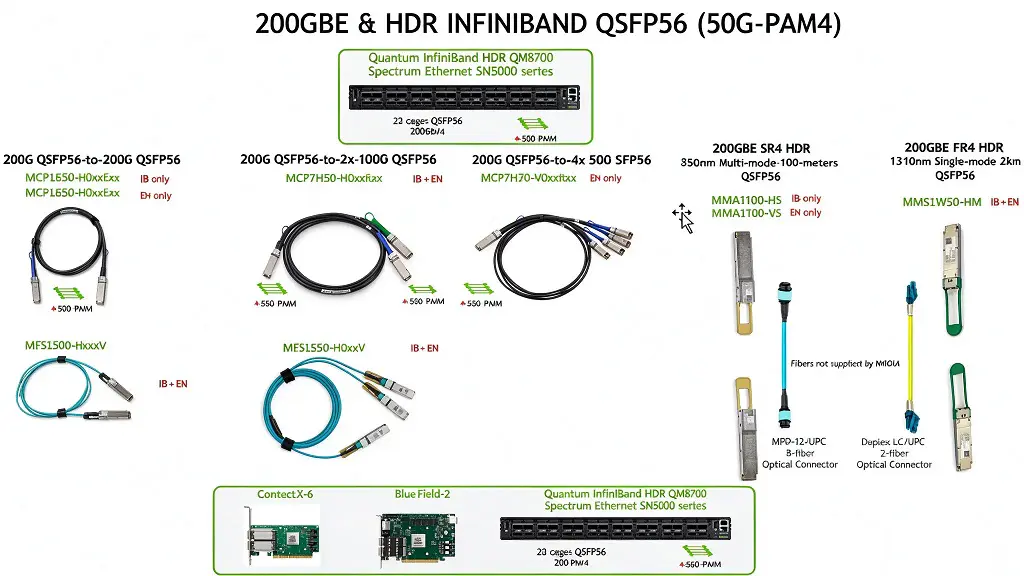
Some transceiver and cabling product families support both Ethernet and InfiniBand applications. For example, certain NVIDIA LinkX products are designed for use across these networking environments.
However, support for both protocols across a product family does not mean that every individual SKU supports both. Always check the exact part number, data sheet, supported link speeds, and device compatibility list.
Scenario 2: The Modules Have the Same Form Factor, Wavelength, and Data Rate
Physical similarities alone do not establish compatibility. For example, a 200G QSFP56 Ethernet module and a 200G InfiniBand HDR module may both use four 50G PAM4 lanes and similar optical interfaces. Nevertheless, their host-interface requirements, signal-processing behavior, management implementation, or device qualification may differ.
Even if a module fits into the port, it may fail to establish a link or may operate unreliably if the relevant specifications do not match.
Scenario 3: The Host Device Supports Multiple Network Protocols
Some network adapters support Virtual Protocol Interconnect (VPI), allowing a compatible adapter to operate in Ethernet or InfiniBand mode, depending on its model and configuration.
For example, certain NVIDIA ConnectX adapters support both networking technologies. This capability does not automatically make every Ethernet or InfiniBand transceiver interchangeable. The adapter model, operating mode, module SKU, firmware, and connected switch must all be considered.
Remember: An optical module that works with a dual-protocol adapter does not make an Ethernet switch and an InfiniBand switch directly interoperable. Both ends must support a compatible link configuration and network protocol.
5. What Should You Check Before Using an Optical Module?
Before installing an Ethernet module in an InfiniBand device, or an InfiniBand module in an Ethernet device, verify the following six items.
1. Form Factor
Confirm that the module's physical form factor matches the port, such as SFP28, QSFP28, QSFP56, QSFP-DD, OSFP, or QSFP112. Physical fit is necessary but not sufficient for compatibility.
2. Per-Lane Data Rate
Check the number of lanes and the signaling rate per lane. For example, a 200G module using four 50G PAM4 lanes is different from a module using another lane configuration, even if their aggregate bandwidth is similar.
3. Optical Specifications
Verify wavelength, transmission distance, single-mode or multimode fiber, connector type, and fiber grade. Ensure that the transmitter and receiver specifications are suitable for the complete optical link.
4. Electrical Interface and Signal Processing
Check the host electrical interface, modulation format, FEC requirements, CDR or DSP behavior, and any required link-training functions. These details can determine whether the host and module establish a reliable connection.
5. Module Identification and Power Requirements
Confirm EEPROM or CMIS management support, vendor identification requirements, power consumption, and thermal limits. Some devices may reject unsupported modules even when their basic optical specifications appear suitable.
6. Equipment and Firmware Compatibility
Check the switch or adapter model, firmware version, supported operating mode, and the manufacturer's approved transceiver list. If the module is not explicitly qualified, consult the equipment vendor or transceiver supplier before deployment.
6. Frequently Asked Questions
Q1: Can I use an Ethernet optical module in an InfiniBand switch?
A: Only if the specific module is supported by that InfiniBand switch and meets the relevant electrical and optical interface requirements. Matching the form factor and optical specifications alone is not enough.
Q2: Can I use an InfiniBand optical module in an Ethernet switch?
A: Not automatically. Check the exact transceiver model against the Ethernet switch's compatibility requirements. A module designed exclusively for an InfiniBand interface may not operate correctly in an Ethernet port.
Q3: Why do Ethernet and InfiniBand modules sometimes look identical?
A: Both technologies use standardized transceiver form factors and can share optical components, wavelengths, fiber types, and connector designs. The main differences may lie in electrical-interface requirements, signaling behavior, firmware identification, and equipment support.
Q4: Are Ethernet and InfiniBand optical modules interchangeable if they use the same wavelength?
A: No. Wavelength is only one part of optical compatibility. You must also verify the data rate, modulation, optical budget, connector, host electrical interface, and device support.
Q5: What is the safest way to choose a compatible optical module?
A: Start with the exact switch or adapter model and port specification. Then match the module's part number, supported protocol, speed, reach, fiber type, and vendor compatibility requirements. If any specification is uncertain, confirm it with the supplier before purchasing.
7. Choose the Right Optical Transceiver with SFPPlaza
Choosing an optical module involves more than matching bandwidth or connector type. The right solution must meet your network's physical-layer requirements and work reliably with your switches, NICs, HCAs, and fiber infrastructure.
At SFPPlaza, we offer optical transceiver solutions across multiple data rates and form factors for data center, enterprise, and high-performance networking applications. Our team can help you evaluate specifications, check equipment compatibility, and identify suitable transceiver options for your deployment.
Need help verifying Ethernet or InfiniBand transceiver compatibility? Contact SFPPlaza with your equipment model, required data rate, optical reach, and existing module part number. We can help you determine which specifications need to be checked before you order.
Contact SFPPlaza for compatibility assistance or explore our optical transceiver products.